blog
The Grand Tour – A Good Reason To Travel

new stories
"Travel is fatal to prejudice, bigotry and narrow mindedness" - Mark Twain

Today I would like to take you on a Tour – A very Grand Tour. This Tour promises exposure to the finest art, culture, and learning of Continental Europe.
It’s a Tour that will ambitiously seeks to teach us all about personal refinement by reaching back in time to the 17th Century. It’s a Tour that was designed to shape a generation whose outlook would influence how European society understood culture, leadership, and public life. So if you don’t mind stepping back in time with me – Let’s go!
The grand tour
This Grand Tour emerged in the aftermath of some very big social upheavals following the Protestant Reformation and the consequenting religious conflicts that followed.
Across Europe, divisions between faith, power, and political authority had produced instability and violence in Central Europe, and so by the late seventeenth and eighteenth centuries many thinkers began turning toward the ideals of the Age of Enlightenment — reason, moderation, and civil order—as an alternative to sectarian conflict.
In this changing world, honour was hoped to come not from conquest but from cultivated leadership.The Grand Tour therefore aimed to form a new kind of leader: men shaped by experience, culture, and disciplined judgement, capable of guiding society toward stability and civility rather than the cycles of violence that had marked the previous century.
The Age of Enlightenment
In response, a new intellectual current began to take hold.
The Age of Enlightenment promoted reason, empirical observation, and civil moderation as alternatives to sectarian dogma and inherited authority.
Within this changing intellectual climate, the British elite developed a distinctive educational tradition: the Grand Tour.
This Grand Tour’s overall purpose was to Instruct the young men to become the modern leaders who would be grounded in reasoned debate, integrity, and measured public conduct. To meet this purpose the Grand Tour was set up to serve as the finishing school for those who would shape the future of England.
Young aristocrats travelled across Europe—particularly to centres such as Paris, Florence, and Rome—to encounter the artistic, political, and intellectual foundations of European civilisation.
The journey was not intended as leisure.It was conceived as the final stage of education for those who would eventually guide public life in Britain.The Tour exposed these travellers to the classical heritage revived during the Renaissance and to the rational spirit of Enlightenment thought. Influenced by thinkers such as John Locke, the emerging ideal of leadership emphasised judgement, moderation, and civic responsibility.
The Grand Tour therefore sought to transform inherited privilege into cultivated leadership, shaping a generation expected to govern not through force or traditional inheritance alone, but through reasoned judgement and public virtue.

Interlectual Foundations
The intelectual background of the Grand Tour lay in two major historical movements: the Renaissance and the Enlightenment.
Renaissance humanists had recovered the writings of classical antiquity, found in Rome and Greece —authors such as Cicero, Virgil, and Plato
—reintroducing ideas about civic virtue, rhetoric, and public responsibility into European education.Students were trained in rhetoric, moral philosophy, and history, learning that leadership required judgement, restraint, and service to the commonwealth.
The Enlightenment did not discard this classical framework; rather, it reframed it through the lens of reason and empirical inquiry.
Thinkers such as Locke argued that legitimate political authority rested on rational consent rather than inherited religious hierarchy.
Knowledge was increasingly grounded in observation and debate rather than dogma.Within this intellectual environment, the ideal gentleman was expected to combine learning with judgement, and education with public responsibility.It didn’t present history as abstraction, but as lived continuity where the Tour would act as a living bridge between the revival of classical antiquity (through Renaissance humanism) and the moral outlook of the Enlightenment. It functioned as a deliberate immersion in Europe’s intellectual and artistic inheritance it would give them an education that went beyond books, where they would have an informed appreciation of art, architecture and antiquity.
The journey

The Grand Tour was usually undertaken in small groups of young aristocrats who had already received a classical education. Many could read Latin and Greek and were familiar with contemporary debates in philosophy, science, and politics.
The Tour served as the final stage of their education—a journey intended to refine judgement and cultivate perspective. Most routes followed a broadly recognised pattern. Travellers left England from Dover and crossed the Channel to Calais before travelling to Paris, the cultural gateway to continental society.
There they learned the social disciplines expected of aristocratic life: conversation, dancing, fencing, horsemanship, and fluency in French, the lingua franca of Europe’s elite.From Paris the journey continued south through Lyon before crossing the Alps into Italy.Travellers often passed through the Mont Cenis Pass or sailed from Marseille to Italian ports such as Genoa or Livorno.
The Italian stage of the journey formed the intellectual climax of the Tour. Cities such as Florence, Venice, and Rome offered access to the artistic and historical legacy that had shaped European civilisation.
"to live without travel is to inhabit ones assumptions as though they were truths"
Italy as a class room
For many British travellers, Italy represented a paradox.
They arrived shaped by Protestant restraint and Anglican religious identity, yet the artistic heritage they sought to study had developed within Catholic Europe.The Enlightenment provided a framework that allowed them to navigate this tension.The intellectual inheritance flowed in layers: Antiquity to Renaissance revival to Enlightenment reflection.
Rather than approaching Italian culture purely through theology, travellers increasingly viewed it through history, aesthetics, and political reflection. Art could be admired for its technical mastery and intellectual achievement rather than its devotional function alone. Using the Enlightenment framework the Tour was able to show how Roman infrastructure underpinned Renaissance cities and how medieval streets still function within contemporary economies.
They would see the civic virtue, proportion, rhetoric, and concept of the well-formed citizen which was first articulated in ancient Greece and Rome. Encountering this layering fostered a deeper understanding of time—how civilisations had risen, adapted, and endured.They would experience how this knowledge was recovered and reinterpreted by Renaissance thinkers and artists,who infused this knowledge into the understanding of the Enlightenment and the current thinking of their time. The Tour became a practical expression of how to translate the legacy of Ancient thinking into lived experiences.
By encountering the classical past, Renaissance achievement, and the living realities of Catholic Europe,the traveller was invited to refine judgment, cultivate taste, and situate faith within a broader intellectual framework. It trained the future statesman to think historically, compare civilisations, and balance admiration with discernment — shaping not only his knowledge, but also his character, shaping inheritance into wisdom and privilege into responsibility. It was, in essence, an education in how to move through the world with discernment, curiosity, and cultivated civility.

proximity and judgement

One of the central assumptions behind the Grand Tour was that proximity refined judgement and encouraged discernment. Books could introduce ideas, but direct encounter deepened understanding.
European cities were not simply destinations; they were classrooms without walls.
In places such as Pompeii, travellers could walk through the perfectly preserved streets of an ancient Roman town. In Florence they studied the masterpieces of the Renaissance, encountering artists such as Michelangelo and Raphael at their source, rather than through reproductions. In Venice they observed the legacy of republican government and civic ceremony.
In Rome they read Latin inscriptions, confronted the ruins of antiquity that transformed ancient history and the architectural grandeur of the classical world, from academic study into lived reality.Standing before ancient ruins or Renaissance paintings, travellers could see how classical ideas had been revived and transformed across centuries. Roman infrastructure underpinned Renaissance cities, while medieval streets continued to shape modern life.
This layering of history encouraged a broader understanding of how civilisations rise, adapt, and endure. Through this experience, the traveller began to see European culture as a continuous intellectual inheritance rather than a collection of isolated historical periods.Travellers learned to evaluate architecture according to proportion, art according to technique and composition,and political systems according to historical context. The education of the Tour therefore extended beyond intellectual learning.
It cultivated taste, perspective, and critical judgement.The process also carried a moral dimension. Moving through the courts, salons, and cultural centres of Europe exposed travellers to wealth, spectacle, and temptation.
Their behaviour abroad was often understood as a test of character.
This type of privilege required self discipline and self-command if it was to justify leadership at home.
how the grand tour still speaks to us
The Grand Tour ultimately represented far more than an appreciation of art or the refinement of manners.Its deeper purpose was the formation of a character – a virtuous character.
By travelling through the cultural centres of Europe, these young British Tourists encountered the intellectual legacy of classical antiquity, the artistic achievements of the Renaissance, and the rational inquiry of the Enlightenment.
This experience encouraged comparison, reflection, and perspective.Travellers were required to examine unfamiliar customs, political systems, and religious traditions,learning to evaluate them through reason rather than inherited assumption.
In this way the Tour transformed education into lived experience.Its enduring value lay in turning knowledge into character.The lessons of books were tested against the complexity of the wider world, shaping a form of leadership grounded in discipline, judgement, and civic responsibility. More than the cities visited or the artworks admired, this transformation was the lasting legacy of the Grand Tour.
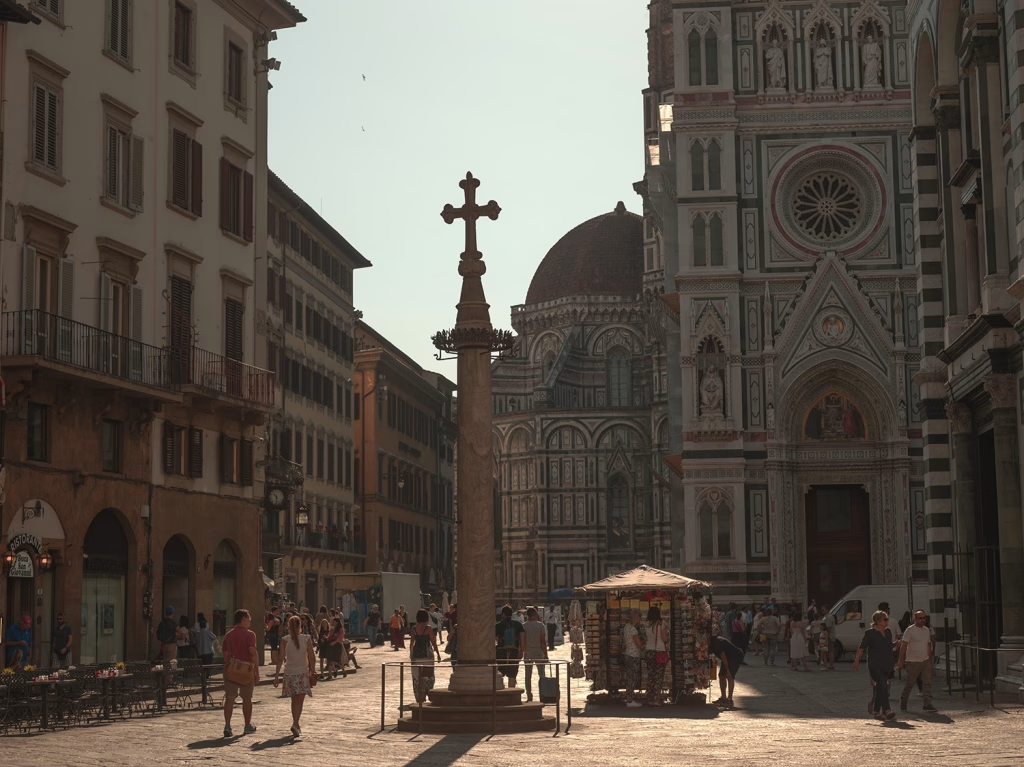
Today you don’t have to be aristocratic, wealthy, or formally educated to embark on a Grand Tour of Europe. What was once a privilege reserved for the sons of the English elite is now open to anyone with curiosity, a willingness to travel, and an interest in the cultures and histories that shaped the modern world.
The cities that once formed the heart of the Grand Tour—Paris, Florence, Rome, and Venice—remain living repositories of art, architecture, philosophy, and human achievement. Modern travellers can walk the same streets, stand before the same masterpieces, and experience the enduring legacy of the Renaissance and the Enlightenment that earlier generations sought to understand.
Yet the true spirit of the Grand Tour was never simply about visiting famous places; it was about encountering ideas, traditions, and perspectives beyond one’s own world. In that sense, the Grand Tour is not merely a historical practice but an enduring way of travelling—one that encourages reflection, observation, and a deeper engagement with culture. Today’s traveller, much like those young aristocrats centuries ago, still has the opportunity to return home not only with memories and photographs, but with a broader understanding of Europe’s cultural inheritance and of the wider world itself.
Travel, then as now, offers more than moving from location to location.
At its best, it invites us to reconsider what we believe and why we believe it.
Travel can ask many things of us, however, its most important question remains simple –
Are you ready and present enough to discover the richness of the Renaissance and a new you?
Join Our Newsletter
Subscribe to receive our latest updates in your inbox!